

2024 Realistic Verified S1000-007 exam dumps Q&As - S1000-007 Free Update
Use Real S1000-007 Dumps - 100% Free S1000-007 Exam Dumps
IBM S1000-007 exam is a challenging exam that requires a deep understanding of AIX v7 Administration concepts and practices. S1000-007 exam covers a wide range of topics, including system installation and configuration, system management, security, and troubleshooting. S1000-007 exam is also designed to test the candidate's ability to apply their knowledge of AIX v7 Administration to real-world scenarios, making it a valuable tool for AIX administrators who want to prove their expertise.
To prepare for the IBM S1000-007 certification exam, candidates can take advantage of various resources such as IBM training courses, study guides, and practice exams. These resources will help candidates to gain a better understanding of the exam content and format, and to identify areas where they need to focus their studies. It is also recommended that candidates gain practical experience in AIX v7 administration by working on real-world projects.
NEW QUESTION # 15
Based on the output from the lparstat command, how many logical processors are configured in the partition?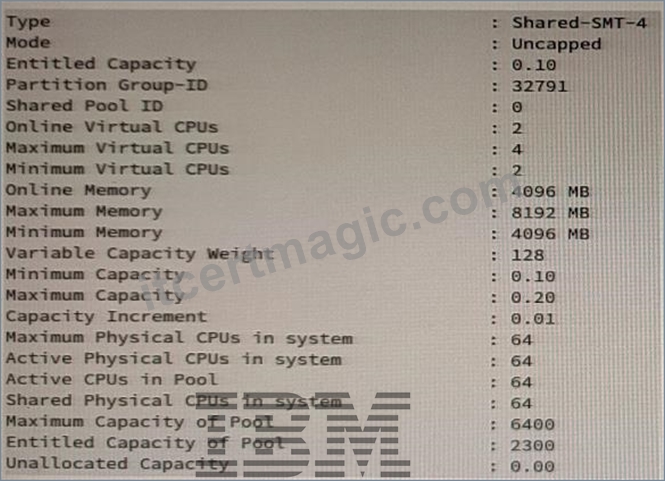
- A. 0
- B. 1
- C. 2
- D. 3
Answer: A
NEW QUESTION # 16
An IT security department would like to limit root user access to only members of the group called system.
Which command will accomplish this?
- A. chadmin user=root system
- B. chadmin group=system root
- C. chgroup admin=root system
- D. cruiser sugroups=system root
Answer: C
NEW QUESTION # 17
What command is used to monitor SAN I/O performance/throughput?
- A. ioo -L
- B. vmstat -i 1
- C. mpstat -w 1
- D. iostat -DIRT 60 10
Answer: D
NEW QUESTION # 18
While executing the following extendvg command, the system administrator receives the following error:
The administrator used the chvg -t command to fix the error.
What is the implication of running this command?
- A. It reduces the maximum number of physical volumes allowed within that volume group.
- B. It reduces the maximum file size allowed within that volume group.
- C. It reduces the maximum number of files allowed within that volume group.
- D. It reduces the maximum number of logical volumes allowed within that volume group.
Answer: B
NEW QUESTION # 19
What AIX feature will allow data to be mirrored to a remote site?
- A. Geographic Logical Volume Manager
- B. Asynchronous Dispersed Logical Volumes
- C. Remote Volume Groups
- D. Mirror Pools
Answer: A
Explanation:
Geographic Logical Volume Manager (GLVM) is an AIX feature that allows data to be mirrored to a remote site [1][2], enabling disaster recovery and improved data availability. GLVM creates a single, unified view of the data across multiple sites, allowing the data to be managed and accessed as if it was all stored in one location. Reference: IBM AIX v7 Administrator Specialty Study Guide, page 546.
NEW QUESTION # 20
When configuring an LPAR profile, what is the meaning of CPU Entitlement?
- A. the count of virtual CPUs configured on an LPAR
- B. the amount of guaranteed CPU time allocated to an LPAR
- C. the number of logical CPUs allocated to an LPAR
- D. Simultaneous Multi Threading setting of an LPAR
Answer: B
Explanation:
CPU Entitlement is a setting in the LPAR profile that defines the amount of guaranteed CPU time allocated to an LPAR. This setting is important for workloads that require a steady level of performance, as it guarantees that the LPAR will always have access to a certain percentage of the processing power on the managed system. Reference: IBM AIX v7 Administrator Specialty Study Guide.
NEW QUESTION # 21
When configuring an LPAR profile, what is the meaning of CPU Entitlement?
- A. the count of virtual CPUs configured on an LPAR
- B. the amount of guaranteed CPU time allocated to an LPAR
- C. Simultaneous Multi Threading setting of an LPAR
- D. the number of logical CPUs allocated to an LPAR
Answer: C
NEW QUESTION # 22
What command is used to monitor SAN I/O performance/throughput?
- A. ioo -L
- B. vmstat -i 1
- C. mpstat -w 1
- D. iostat -DIRT 60 10
Answer: D
Explanation:
The command used to monitor SAN I/O performance/throughput is iostat -DIRT 60 10. The iostat command is used to monitor I/O performance and throughput on a SAN device. The DIRT (Disk I/O Response Time) flag can be used to display the response time for each I/O request. The last two arguments, 60 and 10, are the interval (in seconds) and the number of iterations respectively. This command will monitor I/O performance/throughput every 60 seconds for 10 iterations.
NEW QUESTION # 23
What is the effect of running the mount -a command?
- A. All automatic file systems are mounted.
- B. Ail file systems set to mount=true are mounted.
- C. All JFS/JFS2 file systems are mounted.
- D. All file systems defined to the system are mounted
Answer: B
NEW QUESTION # 24
Which statement is true regarding the snap command?
- A. All options are enabled by default.
- B. By default, it will check there is enough space where the data is to be stored.
- C. It collects performance related data.
- D. The data must be stored in /tmp.
Answer: B
Explanation:
"The command to limit root user access to only members of the group called system is chadmin group=system root. This command will set the primary group of the root user to the system group, thereby limiting root user access to only members of that group. This command can be used to set any user's primary group, not just root." The source of this information is the IBM AIX v7 Administrator Specialty Study Guide.
NEW QUESTION # 25
What is a benefit of using mksysb to backup a system?
- A. The image contains a backup of all application and user data.
- B. The image contains a backup of all volume groups and logical volumes.
- C. The image contains a backup of all file systems.
- D. The image can be used to restore the rootvg volume group of the system.
Answer: A
NEW QUESTION # 26
A client is running multiple AIX, IBM i and Linux partitions on an IBM Power E980 system. Which command allows the administrator to check the number of processors, amount of memory, and list the devices on the AIX partition?
- A. prtconf
- B. syssnap -gc
- C. Iparstat -i
- D. lsdev
Answer: B
NEW QUESTION # 27
A SAN administrator increased the size of a LUN device (hdisk) that is being used by a AIX LPAR. However, the system administrator does not see the new size using the lsvg or Ispv commands.
Which command updates the system with the new size?
- A. cfgmgr
- B. chvg -g
- C. synclvodm
- D. extendpv
Answer: A
Explanation:
The cfgmgr command updates the system configuration database with the current configuration of the devices attached to the system. When the SAN administrator increases the size of a LUN device (hdisk), it is not automatically reflected on the AIX LPAR. Running the cfgmgr command updates the system with the new size information and makes it visible to the system administrator.
NEW QUESTION # 28
An administrator starts an AIX LPAR and wants to monitor the boot process using the HMC console.
Which command in HMC SSH session lists all managed systems, LPARs on them and offers an easy way to open a console window to an AIX LPAR?
- A. lsrefcode
- B. vtmenu
- C. lssyscfg
- D. mkvterm
Answer: C
Explanation:
According to the IBM AIX v7 Administrator Specialty Study Guide, the lssyscfg command is used to display detailed information about a system configuration. It can also be used to open a virtual terminal session to an AIX LPAR.
NEW QUESTION # 29
While trying to extend a file system named /work an administrator receives the following error. 0516-787 extendlv: Maximum allocation for logical volume fslv00 is 256.
What must be done to allow the file system to be extended?
- A. Change the file system's maximum capacity.
- B. Increase the setting for maximum number of logical partitions for that logical volume.
- C. Increase the volume group's maximum limit of logical partitions per logical volume.
- D. Change the logical volume type to jfs2 as JFS logical volumes cannot extend past 256.
Answer: B
NEW QUESTION # 30
Which file starts the System Resource Controller?
- A. /etc/inittab
- B. /etc/rc.d/rc.2
- C. /etc/rc.local
- D. /etc/rc.srcmstr
Answer: D
Explanation:
The System Resource Controller (SRC) is the main process that starts other background processes when the system boots. It is started through the /etc/rc.srcmstr script which is run by the init process. This script reads the /etc/inittab file and starts the necessary processes. Reference: IBM AIX v7 Administrator Specialty Study Guide.
NEW QUESTION # 31
When the system boots it stops and displays reference code 551. This reference code means the rootvg will not varyon. What is the best way for the administrator to proceed?
- A. Reinstall AIX or restore from a mksysb.
- B. Restart the system.
- C. Perform a maintenance mode boot of AIX and diagnose/fix the problem.
- D. Perform a debug boot of AIX and diagnose/fix the problem.
Answer: C
NEW QUESTION # 32
What is the effect of running the mount -a command?
- A. Ail file systems set to mount=true are mounted.
- B. All automatic file systems are mounted.
- C. All file systems defined to the system are mounted
- D. All JFS/JFS2 file systems are mounted.
Answer: C
Explanation:
This command is used to mount all file systems defined in the /etc/filesystems file, as well as any file systems that have the mount=true attribute set in the /etc/filesystems file. According to the IBM AIX v7 Administrator Specialty Study Guide, "the mount -a command mounts all file systems specified in the /etc/filesystems file, including file systems with the mount=true parameter set. The mount -a command is normally issued at system startup or when a new file system is added to the system."
NEW QUESTION # 33
When attempting to recover a corrupted file system an administrator runs the command fsckagainst the unmounted file system and receives the following error: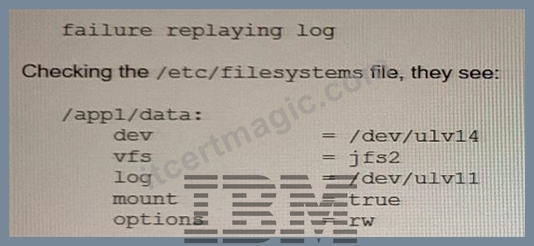
After confirming that the file system is not mounted, what should the administrator do next?
- A. Run fsck: with the -F (force) flag.
- B. Run logrcvr /dev/ulv14 .
- C. Run logform /dev/u1v11.
- D. Convert the log to INLINE.
Answer: C
NEW QUESTION # 34
While executing the following extendvg command, the system administrator receives the following error:
The administrator used the chvg -t command to fix the error.
What is the implication of running this command?
- A. It reduces the maximum number of physical volumes allowed within that volume group.
- B. It reduces the maximum file size allowed within that volume group.
- C. It reduces the maximum number of files allowed within that volume group.
- D. It reduces the maximum number of logical volumes allowed within that volume group.
Answer: A
Explanation:
The chvg command with the -t option is used to reduce the maximum number of physical volumes (PVs) allowed in a volume group (VG). This is necessary when the number of PVs in a VG exceeds the maximum allowed. Reference: IBM AIX v7 Administration Specialty Study Guide (section 10.3.3, pp. 641-642).
NEW QUESTION # 35
......
IBM S1000-007 exam is an essential certification for IT professionals who work with IBM AIX v7 operating systems. S1000-007 exam validates the candidate's knowledge and skills in AIX administration and provides a competitive edge in the job market. With this certification, professionals can demonstrate their commitment to their field and enhance their career prospects.
Pass S1000-007 exam Updated 48 Questions: https://itcertspass.itcertmagic.com/IBM/real-S1000-007-exam-prep-dumps.html