

[Dec 16, 2025] Prepare For The NSK300 Question Papers In Advance
NSK300 PDF Dumps Real 2025 Recently Updated Questions
Netskope NSK300 Exam Syllabus Topics:
| Topic | Details |
|---|---|
| Topic 1 |
|
| Topic 2 |
|
| Topic 3 |
|
| Topic 4 |
|
| Topic 5 |
|
NEW QUESTION # 18
You deployed Netskope Cloud Security Posture Management (CSPM) using pre-defined benchmark rules to monitor your cloud posture in AWS, Azure, and GCP. You are asked to assess if you can extend the Netskope CSPM solution by creating custom rules for each environment.
Which statement is correct?
- A. Custom rules using Domain Specific Language are only available when using SSPM.
- B. With Netskope CSPM, you can create custom rules using Domain Specific Language for AWS. Azure, and GCP
- C. With Netskope CSPM, you can create custom rules using Domain Specific Language for AWS. Azure, but not for GCP.
- D. You will need to evaluate SaaS Security Posture Management (SSPM) in addition to CSPM so that rules applied to GCP will align with Google Workspace
Answer: B
Explanation:
Netskope Cloud Security Posture Management (CSPM) allows for the creation of custom rules using Domain Specific Language (DSL) for all three major cloud platforms: AWS, Azure, and GCP. This capability is integral to CSPM and enables organizations to tailor their security posture assessments to their specific needs across different cloud environments.
The ability to create custom rules using DSL within Netskope CSPM for AWS, Azure, and GCP is documented in the Netskope Knowledge Portal. It provides detailed instructions on how to build custom rules under Policies > Security Posture > Profiles & Rules for security assessment of resources across these cloud platforms
NEW QUESTION # 19
You deployed the Netskope Client for Web steering in a large enterprise with dynamic steering. The steering configuration includes a bypass rule for an application that is IP restricted. What is the source IP for traffic to this application when the user is on-premises at the enterprise?
- A. DHCP assigned RFC1918 IPv4
- B. Loopback IPv4
- C. Enterprise Egress IPv4
- D. Netskope data plane gateway IPv4
Answer: C
Explanation:
* When a user is on-premises at the enterprise and accesses an application that is IP restricted, the source IP for traffic to this application is the Enterprise Egress IPv4 address.
* The Enterprise Egress IP represents the external IP address of the enterprise network as seen by external services or applications.
* This IP address is used for communication between the user's device and external resources, including applications that are IP restricted. References:
* The answer is based on general knowledge of networking concepts and how IP addresses are used in enterprise environments.
NEW QUESTION # 20
You created a Real-time Protection policy that blocks all activities to non-corporate S3 buckets, but determine that the policy is too restrictive. Specifically, users are complaining that normal websites have stopped rendering properly.
How would you solve this problem?
- A. Create a Real-time Protection policy to allow the Download activity to the Cloud Storage category
- B. Create a Real-time Protection policy to allow the Browse activity to the Cloud Storage category
- C. Create a Real-time Protection policy to allow the Download activity to the Amazon S3 application
- D. Create a Real-time Protection policy to allow the Browse activity to the Amazon S3 application.
Answer: B
Explanation:
To solve the problem of normal websites not rendering properly due to a Real-time Protection policy that blocks all activities to non-corporate S3 buckets, the best solution is to create a Real-time Protection policy to allow the Browse activity to the Cloud Storage category. This approach will enable users to view content from various cloud storage services, including Amazon S3, without allowing full access to non-corporate S3 buckets. It's a more granular and less restrictive policy that allows necessary browsing activities while still maintaining control over the upload and download activities to non-corporate buckets1.
The Netskope Knowledge Portal provides information on how to configure Real-time Protection policies, including how to set up policies that allow certain activities while blocking others1. Additionally, the Netskope Community Forum offers insights into best practices for policy configuration to avoid overly restrictive rules that can impact normal web browsing
NEW QUESTION # 21
You are implementing Netskope Cloud Exchange in your company lo include functionality provided by third-party partners. What would be a reason for using Netskope Cloud Risk Exchange in this scenario?
- A. to map multiple scores to a normalized range
- B. to feed SOC with detection and response services
- C. to ingest events and alerts from a Netskope tenant
- D. to automate service tickets from alerts of interest
Answer: D
Explanation:
The reason for using Netskope Cloud Risk Exchange in this scenario is to automate service tickets from alerts of interest. Netskope Cloud Risk Exchange (CRE) is designed to ingest user, device, and application risk scores, creating a dashboard view of contributors to your company's overall risk score and trend. One of the key functionalities of CRE is to trigger risk-reducing actions through business rules that are tuned to a weighted score. Automating service tickets from alerts of interest is a part of this functionality, as it allows for the automatic creation of tickets in response to specific alerts, streamlining the process of addressing potential security issues12.
NEW QUESTION # 22
A company's architecture includes a server subnet that is logically isolated from the rest of the network with no Internet access, no default gateway, and no access to DNS. New resources can only be provisioned on virtual resources in that segment and there is a firewall that is tunnel-capable securing the perimeter of the segment. The only requirement is to have content filtering for any server that might access the Internet using a browser.
Which two Netskope deployment methods would achieve this requirement? (Choose two.)
- A. Deploy a mobile profile on the servers.
- B. Deploy IPsec or GRE tunnels in the segment to steer traffic from the servers to Netskope.
- C. Deploy Data Plane on Premises (DPoP) with a proxy configuration on the servers.
- D. Install the Netskope Client on the servers
Answer: B,C
Explanation:
For a server subnet that is isolated and requires content filtering for any server that might access the Internet using a browser, the two Netskope deployment methods that would meet this requirement are:
* B. Deploy Data Plane on Premises (DPoP) with a proxy configuration on the servers: Deploying DPoP would allow the isolated servers to connect to the Netskope cloud for content filtering through a proxy configuration.This setup would enable the servers to have controlled access to the Internet for content filtering purposes without requiring direct Internet access1.
* C. Deploy IPsec or GRE tunnels in the segment to steer traffic from the servers to Netskope: By deploying IPsec or GRE tunnels, the traffic from the servers can be securely directed to Netskope for content filtering.This method is suitable for environments where servers do not have direct Internet access, as the tunnel provides a secure path for traffic to reach Netskope's cloud services1.
These deployment methods are designed to work in environments with strict network isolation and provide the necessary content filtering capabilities for servers accessing the Internet.
The deployment methods and their suitability for isolated server subnets are based on Netskope's documentation and resources, which detail various deployment options and their use cases21.
NEW QUESTION # 23
Review the exhibit.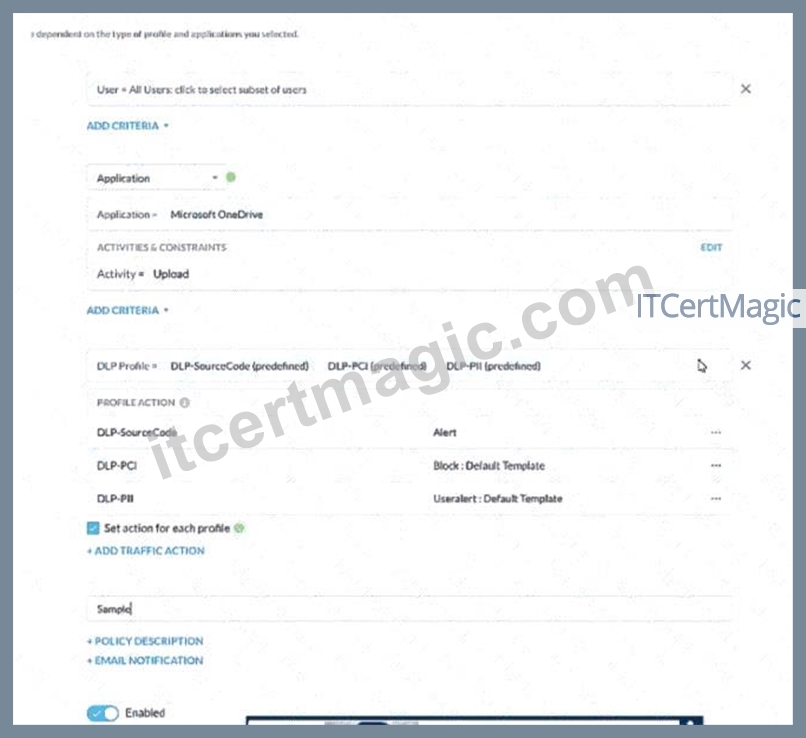
A user has attempted to upload a file to Microsoft OneDrive that contains source code with Pll and PCI data.
Referring to the exhibit, which statement Is correct?
- A. The user will be blocked and a single Incident will be generated referencing the DLP-PCI profile.
- B. The user will be blocked and a separate incident will be generated for each of the matching DLP profiles.
- C. The user will be blocked and a single Incident will be generated referencing all of the matching DLP profiles
- D. The user will be alerted and a single incident will be generated referencing the DLP-PII profile.
Answer: B
NEW QUESTION # 24
You are using Netskope CSPM for security and compliance audits across your multi-cloud environments. To decrease the load on the security operations team, you are researching how to auto-re mediate some of the security violations found in low-risk environments.
Which statement is correct in this scenario?
- A. You can use Netskope Cloud Exchange for auto-remediation of security violation results.
- B. You can use Netskope API-enabled Protection for auto-remediation of security violation results.
- C. Netskope does not support automatic remediation of security violation results due to the high risk associated with it.
- D. You can use Netskope Auto-remediation frameworks from the public Netskope GitHub Open Source repository for auto-re mediation of security violation results.
Answer: D
Explanation:
Netskope supports automatic remediation of security violations through its Auto-Remediation frameworks, which are available in the public Netskope GitHub Open Source repository. These frameworks allow for the automatic mitigation of risks associated with security misconfigurations in your cloud environment. The Netskope Auto-Remediation framework for AWS, for example, deploys a set of AWS Lambda functions that query the Netskope API at scheduled intervals and automatically mitigates supported violations1. Similarly, there are frameworks for GCP and other cloud environments that follow the same principle2. This capability is particularly useful for low-risk environments where the security operations team's workload can be reduced by automating the remediation process.
The answer is based on the information provided by Netskope's community resources and documentation, which detail the use of their Auto-Remediation frameworks for various cloud platforms
NEW QUESTION # 25
A company's architecture includes a server subnet that is logically isolated from the rest of the network with no Internet access, no default gateway, and no access to DNS. New resources can only be provisioned on virtual resources in that segment and there is a firewall that is tunnel-capable securing the perimeter of the segment. The only requirement is to have content filtering for any server that might access the Internet using a browser.
Which two Netskope deployment methods would achieve this requirement? (Choose two.)
- A. Deploy a mobile profile on the servers.
- B. Deploy IPsec or GRE tunnels in the segment to steer traffic from the servers to Netskope.
- C. Deploy Data Plane on Premises (DPoP) with a proxy configuration on the servers.
- D. Install the Netskope Client on the servers
Answer: B,C
Explanation:
For a server subnet that is isolated and requires content filtering for any server that might access the Internet using a browser, the two Netskope deployment methods that would meet this requirement are:
B . Deploy Data Plane on Premises (DPoP) with a proxy configuration on the servers: Deploying DPoP would allow the isolated servers to connect to the Netskope cloud for content filtering through a proxy configuration. This setup would enable the servers to have controlled access to the Internet for content filtering purposes without requiring direct Internet access1.
C . Deploy IPsec or GRE tunnels in the segment to steer traffic from the servers to Netskope: By deploying IPsec or GRE tunnels, the traffic from the servers can be securely directed to Netskope for content filtering. This method is suitable for environments where servers do not have direct Internet access, as the tunnel provides a secure path for traffic to reach Netskope's cloud services1.
These deployment methods are designed to work in environments with strict network isolation and provide the necessary content filtering capabilities for servers accessing the Internet.
NEW QUESTION # 26
You have users connecting to Netskope from around the world You need a way for your NOC to quickly view the status of the tunnels and easily visualize where the tunnels are located Which Netskope monitoring tool would you use in this scenario?
- A. Web Usage Summary in Advanced Analytics
- B. Network Steering in Digital Experience Management
- C. Network Events in Skope IT
- D. Alerts in Skope IT
Answer: B
Explanation:
Network Steering in Digital Experience Management is the appropriate Netskope monitoring tool for this scenario. It allows the Network Operations Center (NOC) to quickly view the status of the tunnels and provides an easy way to visualize the locations of the tunnels. This tool is designed to give a clear overview of network health and performance, which is essential for managing global connectivity and ensuring the reliability of the service.
NEW QUESTION # 27
Your company purchased Netskope's Next Gen Secure Web Gateway You are working with your network administrator to create GRE tunnels to send traffic to Netskope Your network administrator has set up the tunnel, keepalives. and a policy-based route on your corporate router to send all HTTP and HTTPS traffic to Netskope. You want to validate that the tunnel is configured correctly and that traffic is flowing.
In this scenario, which two statements are correct? (Choose two.)
- A. You must use your own monitoring tools to verify that the tunnel is up.
- B. You can verify that the tunnel is up in the Netskope Trust portal at https://trust netskope.com/.
- C. You can use your local router or network device to verify that keepalives are being received and traffic is flowing to Netskope.
- D. You can verify that the tunnel is up and receiving traffic in the Netskope Ul under Settings > Security Cloud Platform > GRE.
Answer: C,D
Explanation:
To validate that the GRE tunnel is configured correctly and that traffic is flowing to Netskope, the correct statements are:
* A: You can use your local router or network device to verify that keepalives are being received and traffic is flowing to Netskope. This is a standard method for checking the health and activity of a GRE tunnel.
* C: You can verify that the tunnel is up and receiving traffic in the Netskope UI under Settings > Security Cloud Platform > GRE. This is a feature provided by Netskope to monitor the status of GRE tunnels directly from the Netskope interface12.
Statement B is incorrect because Netskope provides its own tools for monitoring the status of the tunnel. Statement D is incorrect because the Netskope Trust portal provides information on the overall service status and updates, not specific tunnel status3.
The references for these answers can be found in the Netskope Knowledge Portal, which provides detailed guidance on configuring and validating GRE tunnels12. Additionally, the Netskope Community Forum offers insights and solutions for deploying and monitoring GRE tunnels
NEW QUESTION # 28
Review the exhibit.
A user has attempted to upload a file to Microsoft OneDrive that contains source code with Pll and PCI data.
Referring to the exhibit, which statement Is correct?
- A. The user will be blocked and a single Incident will be generated referencing the DLP-PCI profile.
- B. The user will be blocked and a single Incident will be generated referencing all of the matching DLP profiles
- C. The user will be blocked and a separate incident will be generated for each of the matching DLP profiles.
- D. The user will be alerted and a single incident will be generated referencing the DLP-PII profile.
Answer: B
NEW QUESTION # 29
You want to verify that Google Drive is being tunneled to Netskope by looking in the nsdebuglog file. You are using Chrome and the Netskope Client to steer traffic. In this scenario, what would you expect to see in the log file?
- A.

- B.

- C.

- D.

Answer: B
Explanation:
When verifying that Google Drive traffic is being tunneled to Netskope using Chrome and the Netskope Client, you would expect to see log entries indicating that the traffic is being directed through Netskope's proxy. Specifically, Option A is correct as it shows the process "google drive" being tunneled tonsProxy. The log entry for Option A indicates that a TLS tunneling flow from a local address and process (Google Drive) is being directed to a host (play.googleapis.com) and then to Netskope's proxy (nsProxy).This is consistent with how Netskope tunnels specified traffic for security and policy enforcement1.
The expected log entries are based on the standard operation of Netskope Client and how it steers traffic to Netskope's cloud services, as detailed in Netskope's documentation1.
NEW QUESTION # 30
You are asked to ensure that a Web application your company uses is both reachable and decrypted by Netskope. This application is served using HTTPS on port 6443. Netskope is configured with a default Cloud Firewall configuration and the steering configuration is set for All Traffic.
Which statement is correct in this scenario?
- A. Enable "Steer non-standard ports" in the steering configuration and create a corresponding Real-time Protection policy to allow the traffic
- B. Enable "Steer non-standard ports" in the steering configuration and add the domain and port as a new non-standard port
- C. Create a Firewall App in Netskope along with the corresponding Real-time Protection policy to allow the traffic.
- D. Nothing is required since Netskope is steering all traffic.
Answer: B
Explanation:
To ensure that the web application using HTTPS on port 6443 is both reachable and decrypted by Netskope, the correct action is toenable "Steer non-standard ports" in the steering configuration and add the domain and port as a new non-standard port. This is because Netskope's default configuration steers standard HTTP
/HTTPS traffic, typically on ports 80 and 443.Since port 6443 is a non-standard port for HTTPS traffic, it requires explicit configuration to be steered through Netskope1.
The process for configuring non-standard ports in Netskope is detailed in the Netskope Knowledge Portal, which provides step-by-step instructions on how to steer HTTP(S) traffic over non-standard ports1. This includes adding the specific non-standard port number in the steering configuration to ensure that traffic to and from that port is properly handled by Netskope.
NEW QUESTION # 31
A company needs to block access to their instance of Microsoft 365 from unmanaged devices. They have configured Reverse Proxy and have also created a policy that blocks login activity for the AD group
"marketing-users" for the Reverse Proxy access method. During UAT testing, they notice that access from unmanaged devices to Microsoft 365 is not blocked for marketing users.
What is causing this issue?
- A. The username in the name ID field is not in the format of the e-mail address.
- B. There is an invalid certificate in the SAML response.
- C. The username in the name ID field does not have the "marketing-users" group name.
- D. There is a missing group name in the SAML response.
Answer: D
Explanation:
The issue is likely caused bya missing group name in the SAML response (A). When access to Microsoft 365 from unmanaged devices is not blocked as expected, despite having a policy in place, it often indicates that the SAML assertion is not correctly identifying the user as a member of the restricted group. In this case, the
"marketing-users" group name should be present in the SAML response to enforce the policy that blocks login activity for this group. If the group name is missing, the policy will not apply, and users will not be blocked as intended.
This explanation is consistent with the configuration requirements for access control using SAML responses, as detailed in Netskope's documentation on Reverse Proxy and SAML integration1.
NEW QUESTION # 32
Review the exhibit.
You created an SSL decryption policy to bypass the inspection of financial and accounting Web categories.
However, you still see banking websites being inspected.
Referring to the exhibit, what are two possible causes of this behavior? (Choose two.)
- A. An incorrect action has been specified.
- B. The policy is in a "disabled" state.
- C. An incorrect category has been selected
- D. The policy is in a "pending changes" state.
Answer: A,C
NEW QUESTION # 33
You are currently designing a policy for AWS S3 bucket scans with a custom DLP profile Which policy action (s) are available for this policy?
- A. Alert only
- B. Alert, Quarantine
- C. Alert, User Notification
- D. Alert, Quarantine. Block, User Notification
Answer: B
Explanation:
When designing a policy for AWS S3 bucket scans with a custom DLP profile in Netskope, the available policy actions areAlertandQuarantine. These actions allow you to be notified when a policy violation occurs and to quarantine sensitive data to prevent potential data loss or exposure. TheAlertaction will notify the designated personnel or system when a match to the DLP profile is found during the scan.
TheQuarantineaction will move the offending file to a secure location where it can be reviewed and dealt with appropriately1.
The information about policy actions for AWS S3 bucket scans is available in the Netskope documentation, which provides guidance on creating API Data Protection policies for scanning S3 buckets and the actions that can be taken when a policy is triggered1.
NEW QUESTION # 34
You do not want a scheduled Advanced Analytics dashboard to be automatically updated when Netskope makes improvements to that dashboard. In this scenario, what would you do to retain the original dashboard?
- A. Copy the dashboard into your Group or Personal folders and schedule from these folders.
- B. Ask Netskope Support to provide the dashboard and import into your Personal folder.
- C. Create a new dashboard from scratch that mimics the Netskope dashboard you want to use.
- D. Download the dashboard you want and Import from File into your Group or Personal folder.
Answer: A
NEW QUESTION # 35
Your client is an NG-SWG customer. They are going to use the Explicit Proxy over Tunnel (EPoT) steering method. They have a specific list of domains that they do not want to steer to the Netskope Cloud.
What would accomplish this task''
- A. Define exception domains in the PAC file.
- B. Create a real-time policy with a bypass action.
- C. Use an SSL decryption policy.
- D. Define exceptions in the Netskope steering configuration
Answer: A
Explanation:
To accomplish the task of not steering specific domains to the Netskope Cloud while using the Explicit Proxy over Tunnel (EPoT) steering method, you would define exception domains in the PAC file (A). This is because the PAC file is used to specify which domains should bypass the proxy and connect directly, thus allowing for granular control over the traffic that is steered to Netskope1.
NEW QUESTION # 36
You are deploying the Netskope Client in a multi-user VDI environment and need to determine the command to deploy the MSI.
Which three parameters are required in this scenario? (Choose three.)
- A. installmode=IDP
- B. autoupdate=on
- C. host=
- D. token=
- E. mode=peruserconfig
Answer: C,D,E
NEW QUESTION # 37
......
NSK300 Dumps and Practice Test (70 Exam Questions): https://itcertspass.itcertmagic.com/Netskope/real-NSK300-exam-prep-dumps.html