

Download Salesforce Development-Lifecycle-and-Deployment-Architect Exam Dumps to Pass Exam Easily in 2025
Get 100% Real Free Salesforce Developer Development-Lifecycle-and-Deployment-Architect Sample Questions
To prepare for the Salesforce Development-Lifecycle-and-Deployment-Architect Certification Exam, candidates should have a strong understanding of the Salesforce platform and its features, as well as experience in designing and developing applications using Apex, Visualforce, and other Salesforce development tools. Candidates should also have experience in managing development projects and teams, as well as expertise in deployment processes and best practices. With this certification, Salesforce developers can demonstrate their proficiency in developing and deploying high-quality, scalable, and secure applications on the Salesforce platform, and become recognized as experts in their field.
NEW QUESTION # 91
A Salesforce Administrator has initiated a deployment using a change set. the deployment has taken more time than usual. What is the potential reason for this?
- A. The change set performance is independent of the included components.
- B. The change set includes new custom objects and custom fields.
- C. The change set includes Field type changes for some objects.
- D. The change set includes changes to permission sets and profiles.
Answer: D
Explanation:
The change set performance may depend on the included components, especially if they are complex or have many dependencies. The change set may take more time than usual if it includes changes to permission sets and profiles, as these components require additional validation and processing. The change set may not take more time if it includes field type changes, new custom objects and fields, or other simple components.
NEW QUESTION # 92
Universal Containers would like to conduct performance testing on its new major release. What three things should the architect consider when discussing performance testing?
Choose 3 answers
- A. Performance tests may be run without advanced notice, but Salesforce will not store performance logs.
- B. Salesforce must be informed at least7 days before starting performance tests.
- C. Salesforce will monitor test activity to ensure there are no issues with Salesforce Services.
- D. A business justification must be provided to Salesforce in order to run performance testing.
- E. Performance tests must be run in a sandbox.
Answer: A,D,E
Explanation:
Explanation
According to the [Salesforce Performance Testing Guide], performance tests must be run in a sandbox, a business justification must be provided to Salesforce, and performance tests may be run without advanced notice, but Salesforce will not store performance logs. Salesforce does not need to be informed 7 days before starting performance tests, and Salesforce will not monitor test activity to ensure there are no issues with Salesforce Services.
NEW QUESTION # 93
Universal Containers has a complex deployment coming up. The deployment will include several Apex classes which depend on custom settings that hold important configuration. How should an Architect manage this deployment?
- A. Manually deploy and populate the custom settings in production prior to theApex Class deployment
- B. Script the deployment of all functionality via the Force.com Migration Tool
- C. Create a custom metadata type and include this in your deployment to production
- D. Manually deploy and populate custom settings in production using a change set
Answer: C
Explanation:
Explanation
C is the correct answer, as creating a custom metadata type and including this in your deployment to production is the best way to manage this deployment. A custom metadata type is a metadata component that can store important configuration data, such as custom settings, and can be deployed along with other components, such as Apex classes. A is incorrect, as scripting the deployment of all functionality via the Force.com Migration Tool is not a good way to manage this deployment, as it does not address the issue of deploying the custom settings that hold the configuration data. B is incorrect, as manually deploying and populating custom settings in production using a change set is not a good way to manage this deployment, as it can introduce errors and inconsistencies, as well as require additional steps and permissions. D is incorrect, as manually deploying and populating the custom settings in production prior to the Apex class deployment is not a good way to manage this deployment, as it can create dependency and timing issues, as well as require additional steps and permissions. You can learn more about this topic in the [Custom Metadata Types] module on Trailhead.
NEW QUESTION # 94
Universal Containers (\)C) is on the Unlimited Edition of Salesforce orgs. Currently, there are four Developer Pro sandboxes used by dev teams for various purposes, one partial copy sandboxes used for training, one full sandbox used for user acceptance testing. There is another full sandbox used for performance testing during the initial launch, and it is no longer being actively used.
A system administrator had reported yesterday that none of the sandboxes can be refreshed.
What is the most probable action an architect can help the system administrator with?
- A. Create a Salesforce support case, someone should know what is wrong.
- B. Delete the full sandbox used for performance testing.
- C. Contact the Salesforce Account Team to do a sandbox License Count.
- D. It appears the org is using more sandboxes than the license permits. The Partial Copy sandbox shouldn't be used.
Answer: C
NEW QUESTION # 95
As a part of technical debt cleanup project, a large list of metadata components has been identified by the business analysts at Universal Containers for removal from the Salesforce org. How should an Architect manage these deletions across sandbox environments and production with minimal impact on other work streams?
- A. Generate a destructivechanges.xml file and deploy the package via the Force.com Migration Tool
- B. Perform deletes manually in a sandbox and then deploy a Change Set to production
- C. Assign business analysts to perform the deletes and split up the work between them
- D. Delete the components in production and then refresh all sandboxes to receive the changes
Answer: A
Explanation:
Explanation
A is the correct answer, as generating a destructivechanges.xml file and deploying the package via the Force.com Migration Tool is the best way to manage the deletions of metadata components across sandbox environments and production with minimal impact on other work streams. A destructivechanges.xml file is a special file that specifies the components to be deleted from an org, and can be deployed using the Force.com Migration Tool, which is a command-line tool that uses the Metadata API to retrieve and deploy metadata components. This method can help to automate and streamline the deletion process, as well as ensure consistency and accuracy across the environments. B is incorrect, as performing deletes manually in a sandbox and then deploying a change set to production is not a good way to manage the deletions, as it can introduce errors and inconsistencies, as well as require additional steps and permissions. C is incorrect, as assigning business analysts to perform the deletes and splitting up the work between them is not a good way to manage the deletions, as it can create confusion and complexity, as well as lack of coordination and integration. D is incorrect, as deleting the components in production and then refreshing all sandboxes to receive the changes is not a good way to manage the deletions, as it can disrupt the production environment and the ongoing development and testing activities in the sandboxes. You can learn more about this topic in the Deploy Changes with the Force.com Migration Tool unit on Trailhead.
NEW QUESTION # 96
Which statement is true for the Staging sandbox in the following diagram?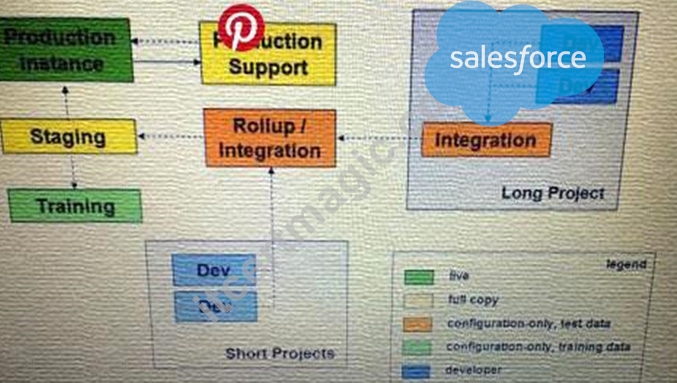
- A. When created or refreshed, the Staging sandbox is a full replica of Production
- B. The Staging environment can only be updated once every two weeks
- C. The Staging sandbox is automatically refreshed on a schedule set by the administrator
- D. Salesforce major releases (e.g., Winter to Spring) always occur in Staging and Production at the same time
Answer: A
Explanation:
The correct statement for the Staging sandbox in the diagram is that when created or refreshed, the Staging sandbox is a full replica of Production, as it is a full copy sandbox that copies all the data and metadata from the production org. Option B is not true, as the Staging sandbox is not automatically refreshed, but manually refreshed by the administrator. Option C is not true, as Salesforce major releases may occur in Staging and Production at different times, depending on the sandbox preview window. Option D is not true, as the Staging environment can be updated more frequently than once every two weeks, depending on the sandbox refresh interval.
NEW QUESTION # 97
Universal Containers (UC) is implementing Salesforce for the first time. Their legacy CRM system is an on premise home-grown application written in Jav a. UC plans to implement a continuous integration process that mirrors their current standard. Under what conditions should an Architect recommend against continuous integration?
- A. There isn't a full sandbox available to leverage
- B. The client does not have budget for additional software
- C. Test scripts will be generated as part of the testing phase
- D. The Salesforce instance has only standard functionality
Answer: D
NEW QUESTION # 98
Salesforce has three major releases a year.
Which type of change introduced by a release can cause automated browser tests to need updating?
- A. New standard fields
- B. DOM changes
- C. Metadata schema changes
- D. New Apex methods
Answer: B
NEW QUESTION # 99
The CEO at Universal Containers (UC) is receiving constant complaints from business stakeholders that the development teams are not frequently delivering value to the end-user. The CEO talked with the CTO, who argues the opposite, explaining that the development teams are delivering value every Sprint.
The architect suggests to the CTO to implement Kanban to solve this disagreement.
How can Kanban help clarify whether value is being delivered to the business?
- A. Kanban can make use of the Salesforce Agile Accelerator to speed up delivery.
- B. Kannan traits includes metrics, like lead time and throughput, which increases transparency.
- C. Kanban limits work in progress, so the executives will know the development team is not overworked.
- D. Kanban teams respond to unplanned work and changes by dropping everything and jumping on the new request, ensuring agility.
Answer: B
Explanation:
Explanation
Kanban can help clarify whether value is being delivered to the business by using metrics, like lead time and throughput, which increase transparency. Lead time measures how long it takes to complete a work item from the time it is requested, and throughput measures how many work items are completed in a given time period.
These metrics can help the business stakeholders see the progress and performance of the development teams, and align their expectations with the reality. Kanban does not respond to unplanned work and changes by dropping everything and jumping on the new request, as this would disrupt the flow and quality of work.
Kanban does not make use of the Salesforce Agile Accelerator, as this is a tool for managing agile projects.
Kanban does limit work in progress, but this is not the main reason why it can help clarify whether value is being delivered to the business.
NEW QUESTION # 100
Universal Containers has a deadline to retire a business -critical application that will no longer be supported on a specific date. What should an Architect recommend?
- A. Business Continuity Plan
- B. Agile Methodology
- C. Requirements Traceability Matrix
- D. Executive Leadership
Answer: A
NEW QUESTION # 101
Cloud Kicks (CK) is launching a new sneaker line during the upcoming holiday season and needs to do a thorough batch data testing before Go-Live. CK is using Salesforce unlimited edition.
What two sandbox types should the architect recommend for batch data testing?
Choose 2 answers
- A. Partial Copy sandbox
- B. Developer sandbox
- C. Full sandbox
- D. Developer Pro sandbox
Answer: A,C
Explanation:
Explanation
The sandbox types that the architect should recommend for batch data testing are Partial Copy sandbox and Full sandbox. These sandbox types allow the testing of large data sets that are similar to the production data.
Developer Pro sandbox and Developer sandbox have limited storage and may not be able to accommodate the data needed for the batch data testing.
NEW QUESTION # 102
Universal Containers wants to introduce data volume testing to resolve ongoing performance defects earlier in the lifecycle. Regulations prohibit the use of production data in non-production environments.
Which two options can the architect recommend?
Choose 2 answers
- A. Request a partial Sandbox copy after the next Salesforce release.
- B. Perform data masking on full sandbox after a refresh.
- C. Use Query Analyzer in production.
- D. Generate mock data that mimics production data shape and volume.
Answer: B,D
Explanation:
The architect should recommend generating mock data that mimics production data shape and volume, and performing data masking on full sandbox after a refresh. These options allow the team to create realistic data sets for testing without violating the regulations that prohibit the use of production data in non-production environments. Requesting a partial sandbox copy after the next Salesforce release is not a valid option, as partial sandboxes are refreshed on demand and not tied to Salesforce releases. Using Query Analyzer in production is not a way to perform data volume testing, as it only analyzes the performance of SOQL queries.
NEW QUESTION # 103
Universal Containers are using Salesforce for Order Management and has integrated with an in-house ERP system for order fulfillment. There is an urgent requirement to include a new order status value from the ERP system in the Order Status pick list in Salesforce. Which are two considerations when addressing the above requirement? Choose 2 answers
- A. Integration with the ERP system may not function as expected.
- B. Existing Apex test classes may start falling in Production.
- C. The change can be performed in Production, as it is a configuration change.
- D. Implement the change in the sandbox, validate, and release to Production.
Answer: A,D
Explanation:
Implementing the change in the sandbox, validating, and releasing to production and considering that the integration with the ERP system may not function as expected are two considerations when addressing the requirement. The change should be performed in the sandbox first, as it is a best practice to test any changes in a non-production environment before deploying them to production. The change may also affect the integration with the ERP system, as it may require updating the mappings, validations, or transformations between the two systems.
NEW QUESTION # 104
Universal Containers CUC) is hiring offshore agile development teams to decrease costs and enhance UC's capability of delivering new features to its customers. However, the CTO Is not able to follow or measure the work of those teams.
What should an architect recommend to increase transparency?
- A. Request the offshore teams to send daily emails to the CTO with the progress of the teams.
- B. Schedule a daily stand-up meeting with representatives of all offshore teams to share the progress of the teams.
- C. A Request the offshore teams to share their work in progress in a virtual Kanban board tool.
- D. Ask the offshore teams to add their progress and status in a shared spreadsheet.
Answer: C
Explanation:
Explanation
A virtual Kanban board tool is a good way to increase transparency and collaboration among agile development teams, as it allows them to visualize their work, track their progress, and identify any bottlenecks or issues. A daily stand-up meeting, a daily email, or a shared spreadsheet are not as effective or efficient as a Kanban board tool.
NEW QUESTION # 105
Universal Containers (UC) has a recruiting application using Metadata API version 35, and deployed it in production last year. The current Salesforce platform is running on API version 36.A new field has been introduced on the object Apex page in API version 36. A UC developer has developed a new Apex page that contains the new field and is trying to deploy the page using the previous deployment script that uses API version 35. What will happen during the deployment?
- A. The deployment script will fail because the platform doesn't support the previous API version 35.
- B. The deployment script will pass because the new field is supported on the current platform version.
- C. The deployment script will fail because the new field is not known for the previous API version 35.
- D. The deployment script will pass because the new field is backward compatible with the previous API version 35.
Answer: C
Explanation:
The deployment script will fail because the new field is not known for the previous API version 35. The Metadata API version determines which components and fields are available for deployment. If a component or field is introduced in a later API version than the one used for deployment, it will not be recognized and will cause an error.
NEW QUESTION # 106
What sandbox type would be appropriate for diagnosing reports of poor performance when accessing certain Visualforce pages?
- A. Partial copy Sandbox.
- B. Full Sandbox
- C. Developer Pro Sandbox.
- D. Developer Sandbox.
Answer: B
Explanation:
Explanation
A full sandbox would be appropriate for diagnosing reports of poor performance when accessing certain Visualforce pages, as it provides a complete copy of the production data and metadata, which allows the developers to replicate and troubleshoot the issue in a realistic environment. A partial copy sandbox would not be appropriate, as it only provides a sample of the production data, which may not reflect the actual volume and complexity of the data that affects the performance. A developer sandbox would not be appropriate, as it only provides a copy of the production metadata, but not the data, which makes it impossible to test the performance of the Visualforce pages with real data. A developer pro sandbox would not be appropriate, as it also only provides a copy of the production metadata, but not the data, which makes it impossible to test the performance of the Visualforce pages with real data.
NEW QUESTION # 107
......
Salesforce Development-Lifecycle-and-Deployment-Architect exam is a challenging and comprehensive test that requires a significant amount of preparation. Candidates must be able to demonstrate their proficiency in various areas, such as configuring and managing version control systems, designing and implementing deployment plans, and troubleshooting issues related to deployment and release management. They must also be able to design and implement testing strategies that ensure the quality and stability of Salesforce applications.
Development-Lifecycle-and-Deployment-Architect Study Guide Realistic Verified Dumps: https://itcertspass.itcertmagic.com/Salesforce/real-Development-Lifecycle-and-Deployment-Architect-exam-prep-dumps.html