

[May 29, 2026] ITCertMagic SPLK-1003 dumps & Splunk Enterprise Certified Admin sure practice dumps
Splunk SPLK-1003 Actual Questions and Braindumps
Splunk SPLK-1003 certification exam is designed to test the knowledge and skills of individuals seeking to become certified Splunk Enterprise administrators. SPLK-1003 exam covers a range of topics related to the configuration, management, and troubleshooting of Splunk deployments, including understanding the architecture of Splunk, configuring and managing Splunk components, securing Splunk, and troubleshooting common issues. Splunk Enterprise Certified Admin certification is intended for individuals who have experience with Splunk and who want to demonstrate their expertise in administering Splunk deployments.
The SPLK-1003 exam is a challenging exam that requires a deep understanding of Splunk Enterprise administration. However, passing SPLK-1003 exam and obtaining the Splunk Enterprise Certified Admin certification can open up new career opportunities and increase earning potential. It is also an excellent way to validate one's knowledge and skills in Splunk Enterprise administration.
NEW QUESTION # 63
What options are available when creating custom roles? (select all that apply)
- A. Restrict search terms
- B. Limit the number of concurrent search jobs
- C. Whitelist search terms
- D. Allow or restrict indexes that can be searched.
Answer: A,B,D
Explanation:
https://docs.splunk.com/Documentation/SplunkCloud/8.2.2106/Admin/ConcurrentLimits
"Set limits for concurrent scheduled searches. You must have the edit_search_concurrency_all and edit_search_concurrency_scheduled capabilities to configure these settings."
NEW QUESTION # 64
Which of the following configuration files are used with a universal forwarder? (Choose all that apply.)
- A. monitor.conf
- B. forwarder.conf
- C. outputs.conf
- D. inputs.conf
Answer: C,D
Explanation:
Reference:
Configuretheuniversalforwarder
NEW QUESTION # 65
What is the correct order of steps in Duo Multifactor Authentication?
- A. 1 Request Login
2 Check authentication / group mapping
3 Authentication Granted
4. Duo MFA
5. Create User session
6. Log into Splunk - B. 1. Request Login 2 Duo MFA
3. Authentication Granted 4 Connect to SAML server
5. Log into Splunk
6. Create User session - C. 1 Request Login 2 Duo MFA
3. Check authentication / group mapping
4 Create User session
5. Authentication Granted
6 Log into Splunk - D. 1 Request Login
2. Connect to SAML server
3 Duo MFA
4 Create User session
5 Authentication Granted 6. Log into Splunk
Answer: A
NEW QUESTION # 66
What is the default character encoding used by Splunk during the input phase?
- A. UTF-8
- B. UTF-16
- C. ISO 8859
- D. EBCDIC
Answer: B
NEW QUESTION # 67
In which phase do indexed extractions in props.conf occur?
- A. Indexing phase
- B. Searching phase
- C. Parsing phase
- D. Inputs phase
Answer: C
Explanation:
Reference:
Configurationparametersandthedatapipeline
NEW QUESTION # 68
How would you configure your distsearch conf to allow you to run the search below? sourcetype=access_combined status=200 action=purchase splunk_setver_group=HOUSTON A)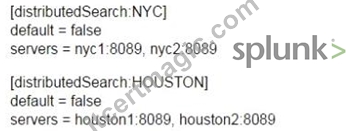
B)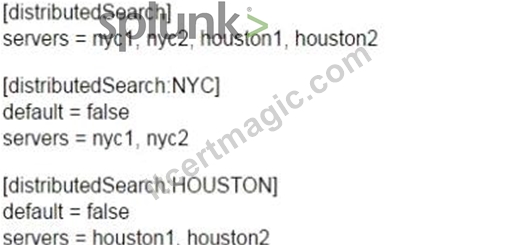
C)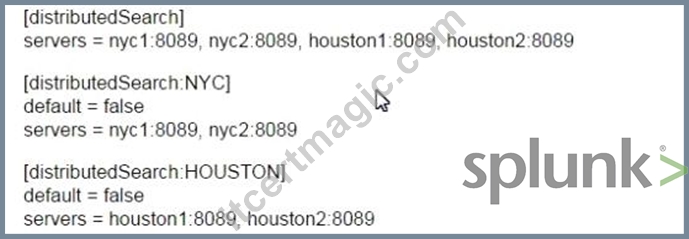
D)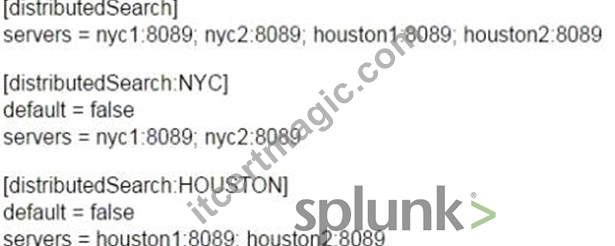
- A. Option C
- B. option A
- C. Option B
- D. Option D
Answer: A
Explanation:
https://docs.splunk.com/Documentation/Splunk/8.0.3/DistSearch/Distributedsearchgroups
NEW QUESTION # 69
Which of the following are methods for adding inputs in Splunk? (select all that apply)
- A. Editing monitor. conf
- B. Editing inputs. conf
- C. CLI
- D. Splunk Web
Answer: B,C,D
NEW QUESTION # 70
When using a directory monitor input, specific source types can be selectively overridden using which configuration file?
- A. sourcetypes . conf
- B. outputs . conf
- C. trans forms . conf
- D. props . conf
Answer: D
Explanation:
When using a directory monitor input, specific source types can be selectively overridden using the props.
conf file. According to the Splunk documentation1, "You can specify a source type for data based on its input and source. Specify source type for an input. You can assign the source type for data coming from a specific input, such as /var/log/. If you use Splunk Cloud Platform, use Splunk Web to define source types. If you use Splunk Enterprise, define source types in Splunk Web or by editing the inputs.conf configuration file." However, this method is not very granular and assigns the same source type to all data from an input. To override the source type on a per-event basis, you need to use the props.conf file and the transforms.conf file2. The props.conf file contains settings that determine how the Splunk platform processes incoming data, such as how to segment events, extract fields, and assign source types2. The transforms.conf file contains settings that modify or filter event data during indexing or search time2. You can use these files to create rules that match specific patterns in the event data and assign different source types accordingly2. For example, you can create a rule that assigns a source type of apache_error to any event that contains the word "error" in the first line2.
NEW QUESTION # 71
Event processing occurs at which phase of the data pipeline?
- A. Input
- B. Indexing
- C. Parsing
- D. Search
Answer: C
Explanation:
Explanation
According to the Splunk documentation1, event processing occurs at the parsing phase of the data pipeline. The parsing phase is where Splunk software processes incoming data into individual events, extracts timestamp information, assigns source types, and performs other tasks to make the data searchable1. The parsing phase can also apply field extractions, event type matching, and other transformations to the events2.
NEW QUESTION # 72
An organization wants to collect Windows performance data from a set of clients, however, installing Splunk software on these clients is not allowed. What option is available to collect this data in Splunk Enterprise?
- A. Use Local Windows network monitoring.
- B. Use Windows Remote Inputs with WMI.
- C. Use Local Windows host monitoring.
- D. Use an index with an Index Data Type of Metrics.
Answer: B
Explanation:
https://docs.splunk.com/Documentation/Splunk/8.1.0/Data/ConsiderationsfordecidinghowtomonitorWindowsdata
"The Splunk platform collects remote Windows data for indexing in one of two ways: From Splunk forwarders, Using Windows Management Instrumentation (WMI). For Splunk Cloud deployments, you must use the Splunk Universal Forwarder on a Windows machines to montior remote Windows data."
NEW QUESTION # 73
Which of the following apply to how distributed search works? (select all that apply)
- A. The search peers pull the data from the forwarders.
- B. Peers run searches in parallel and return their portion of results.
- C. The search head dispatches searches to the peers
- D. The search head consolidates the individual results and prepares reports
Answer: B,C,D
Explanation:
Explanation
Users log on to the search head and run reports: - The search head dispatches searches to the peers - Peers run searches in parallel and return their portion of results - The search head consolidates the individual results and prepares reports
NEW QUESTION # 74
What type of data is counted against the Enterprise license at a fixed 150 bytes per event?
- A. Internal Splunk data
- B. Metrics data
- C. License data
- D. Internal Windows logs
Answer: B
Explanation:
Explanation/Reference: https://answers.splunk.com/answers/581441/how-is-the-splunk-license-measured.html
NEW QUESTION # 75
How can native authentication be disabled in Splunk?
- A. Create an empty $SPLUNK_HOME/etc/passwd file
- B. Set SPLUNK_AUTHENTICATION=false in splunk-launch.conf
- C. Remove the $SPLUNK_HOME/etc/passwd file
- D. Set nativeAuthentication=false in authentication.conf
Answer: A
NEW QUESTION # 76
Which of the following are supported configuration methods to add inputs on a forwarder? (Select all that apply.)
- A. Edit inputs.conf
- B. CLI
- C. Edit forwarder.conf
- D. Forwarder Management
Answer: A
Explanation:
Explanation/Reference: https://docs.splunk.com/Documentation/Forwarder/7.3.1/Forwarder/Configuretheuniversalforwarder
NEW QUESTION # 77
Where can scripts for scripted inputs reside on the host file system? (select all that apply)
- A. $S?LUNK_HOME/etc/apps/<your_app>/bin_
- B. $SPLUNK_HOME/etc/apps/bin
- C. $SFLUNK_HOME/bin/scripts
- D. $SPLUNK_HOME/etc/system/bin
Answer: D
NEW QUESTION # 78
What is the difference between the two wildcards ... and - for the monitor stanza in inputs, conf?
- A. There is no difference, they are interchangable and match anything beyond directory boundaries.
- B. ... is not supported in monitor stanzas
- C. * matches anything in that specific directory path segment, whereas ... recurses through subdirectories as well.
- D. ... matches anything in that specific directory path segment, whereas - recurses through subdirectories as well.
Answer: C
Explanation:
Explanation
https://docs.splunk.com/Documentation/Splunk/7.3.0/Data/Specifyinputpathswithwildcards The ellipsis wildcard searches recursively through directories and any number of levels of subdirectories to find matches.
If you specify a folder separator (for example, //var/log/.../file), it does not match the first folder level, only subfolders.
* The asterisk wildcard matches anything in that specific folder path segment.
Unlike ..., * does not recurse through subfolders.
NEW QUESTION # 79
Which of the following is true regarding LDAP integration with Splunk Enterprise?
- A. Mappings can be changed at any time if the user has the power role.
- B. Having the change authentication capability will not allow setup of the LDAP integration.
- C. LDAP integration will not function unless all groups are mapped to an LDAP group.
- D. A user cannot log in via LDAP unless they have an associated Splunk role.
Answer: D
Explanation:
In Splunk Enterprise, when integrating with an LDAP (Lightweight Directory Access Protocol) directory for authentication, user access is governed by the mapping between LDAP groups and Splunk roles. A user authenticated via LDAP must belong to at least one LDAP group that is mapped to a Splunk role. Without this mapping, the user can authenticate successfully against LDAP but will not be granted any role privileges inside Splunk, and therefore cannot log in to the Splunk web interface.
Splunk documentation explicitly states:
"When you integrate Splunk Enterprise with LDAP, a user must be assigned at least one Splunk role through an LDAP group mapping. If the user does not belong to a mapped group, they cannot log into Splunk." This ensures that user permissions are inherited from LDAP-to-role mappings and provides centralized management of authentication and authorization.
Reference (Splunk Documentation):
* Splunk Enterprise Admin Manual # Securing Splunk Enterprise # Authenticate users with LDAP
* authentication.conf.spec and example # LDAP configuration and role mapping
* Splunk Docs: "Configure LDAP authentication"
NEW QUESTION # 80
What is the name of the object that stores events inside of an index?
- A. Container
- B. Bucket
- C. Data layer
- D. Indexer
Answer: B
Explanation:
A bucket is the object that stores events inside of an index. According to the Splunk documentation1, "An index is a collection of directories, also called buckets, that contain index files. Each bucket represents a specific time range." A bucket can be in one of several states, such as hot, warm, cold, frozen, or thawed1. Buckets are managed by indexers or clusters of indexers1.
NEW QUESTION # 81
Which valid bucket types are searchable? (select all that apply)
- A. Hot buckets
- B. Warm buckets
- C. Cold buckets
- D. Frozen buckets
Answer: A,B,C
Explanation:
Explanation
Hot/warm/cold/thawed bucket types are searchable. Frozen isn't searchable because its either deleted at that state or archived.
NEW QUESTION # 82
Which option accurately describes the purpose of the HTTP Event Collector (HEC)?
- A. An agent-based HTTP input that is secure and scalable and that does not require the use of forwarders.
- B. A token-based HTTP input that is secure and scalable and that does not require the use of forwarders.
- C. A token-based HTTP input that is insecure and non-scalable and that does not require the use of forwarders.
- D. A token-based HTTP input that is secure and scalable and that requires the use of forwarders.
Answer: B
Explanation:
Explanation/Reference: http://dev.splunk.com/view/event-collector/SP-CAAAE6M
NEW QUESTION # 83
Which of the following indexes come pre-configured with Splunk Enterprise? (select all that apply)
- A. _external
- B. _thefishbucket
- C. _license
- D. _lnternal
Answer: B,D
Explanation:
Explanation
https://docs.splunk.com/Documentation/Splunk/8.0.5/Indexer/Howindexingworks
NEW QUESTION # 84
When would the following command be used?
- A. To verify the integrity of a SmartStore bucket.
- B. To verify the integrity of a local bucket.
- C. To verify the integrity of a SmartStore index.
- D. To verify' the integrity of a local index.
Answer: B
Explanation:
To verify the integrity of a local bucket. The command ./splunk check-integrity -bucketPath [bucket path] [- verbose] is used to verify the integrity of a local bucket by comparing the hashes stored in the l1Hashes and l2Hash files with the actual data in the bucket1. This command can help detect any tampering or corruption of the data.
NEW QUESTION # 85
When running the command shown below, what is the default path in which deployment server. conf is created?
splunk set deploy-poll deployServer:port
- A. SFLUNK_HOME/etc/deployment
- B. SPLUNK_HOME/etc/system/default
- C. SPLUNK_KOME/etc/apps/deployment
- D. SPLUNK_HOME/etc/system/local
Answer: B
Explanation:
Explanation
https://docs.splunk.com/Documentation/Splunk/8.1.1/Updating/Definedeploymentclasses#Ways_to_define_serv
"When you use forwarder management to create a new server class, it saves the server class definition in a copy of serverclass.conf under $SPLUNK_HOME/etc/system/local. If, instead of using forwarder management, you decide to directly edit serverclass.conf, it is recommended that you create the serverclass.conf file in that same directory, $SPLUNK_HOME/etc/system/local."
NEW QUESTION # 86
......
Latest SPLK-1003 Pass Guaranteed Exam Dumps with Accurate & Updated Questions: https://itcertspass.itcertmagic.com/Splunk/real-SPLK-1003-exam-prep-dumps.html