

TAKE Fire Protection Specialist CFPS PRACTICE QUESTIONS FOR AMAZING RESULTS
NFPA CFPS Exam Dumps Are Essential To Get Good Marks
NEW QUESTION # 50
Four-way automatic sprinkler bracing prevents both lateral and:
- A. Longitudinal movement
- B. Diagonal movement
- C. Horizontal movement
- D. Vertical movement
Answer: A
Explanation:
(Changed from A need comments)
In response to your question we have reviewed NFPA 13, 2013 edition as the applicable standard. Our informal interpretation is that providing additional support for the net vertical reaction forces is not required.
Your application has a Cp of 0.35 where the requirements of net vertical reaction forces do not apply.
The concern is with the
pipe moving in a vertical direction. The bracing attached in a horizontal orientation may not resist the vertical movement of the pipe for higher Cp seismic loads. Section 9.3.5.10 states, §Where the horizontal seismic loads used exceed 0.5Wp and the brace angle is less than 45 degrees from vertical or where the horizontal seismic load exceeds 1.0 Wp and the brace angle is less than
60 degrees from vertical, the braces shall be arranged to resist the net vertical reaction produced by the horizontal load. ¨ The NFPA 13 Handbook further clarifies this section indicating this requirement was first introduced in the
1996 edition of NFPA 13
addressing the need to protect against upward vertical movement of the pipe as a result of a strong horizontal load in combination with a limited brace angle from vertical. Previous editions did not specifically address such vertical movement. When needed, this additional support could take the form of hanger rods located in close proximity of braces and reinforced against buckling by use of pipe sheathing or other means. This does not apply for your application.
NEW QUESTION # 51
Which of the following is produced by pyrolysis and/or incomplete combustion of organic materials and is referred to as an organic irritant?
- A. Hydrogen
- B. Argon
- C. Cyanide
- D. Formaldehyde
Answer: C
NEW QUESTION # 52
What is the maximum allowable sound pressure level (SPL) for a fire alarm system?
- A. 130 dBA
- B. 50 dBA
- C. 100 dBA
- D. 30 dBA
Answer: C
Explanation:
Explanation
According to NFPA 72, the maximum sound pressure level (SPL) for a fire alarm system is 110 dBA at the minimum hearing distance from the audible appliance1.However, this limit can be exceeded if the sound pressure level measured 2 000 mm above floor level is not more than 100 dBA2. Sound pressure level is a measure of the intensity of sound at a given point in space, expressed in decibels (dB). The higher the SPL, the louder the sound.For comparison, a normal conversation is about 60 dB, a jet engine is about 140 dB, and a gunshot is about 160 dB3.References:Sound Pressure Levels - NFPA;NFPA fire alarm sound level - EntirelySafe.com;Subsection 907.5 - Occupantnotification systems - Casetext;How Loud Is a Fire Alarm In Decibels (dB)? With Noise Comparison Chart;The Ontario Building Code | Audibility of Alarm Systems.
NEW QUESTION # 53
The total head of a fire pump is:
- A. psi rating as the liquid passes through the pipe
- B. the static pressure of water at the intake of the pump
- C. the energy imparted to the liquid as it passes through the orifice
- D. the energy imparted to the liquid as it passes through the pump
Answer: D
NEW QUESTION # 54
The goals of the first edition of NFPA 13D were to provide sufficient time for safe egress or rescue, economic viability, and
- A. alert the fire department.
- B. prevent flashover.
- C. limit damage to the dwelling.
- D. limit water damage.
Answer: C
Explanation:
Explanation
According to the web search results, the goals of the first edition of NFPA 13D were to provide sufficient time for safe egress or rescue, economic viability, and limit damage to the dwelling. The first edition of NFPA 13D was published in 1975 and was based on the concept of a "life safety" sprinkler system that was intended to protect the occupants of one- and two-family dwellings and manufactured homes from fire.The first edition of NFPA 13D stated that the system was not designed to protect the property or contents from fire damage, but rather to provide a tenable environment for escape or rescue1.The first edition of NFPA 13D also recognized the need for economic viability of the system, and therefore allowed for reduced water supply and piping requirements compared to other sprinkler standards2.The first edition of NFPA 13D did not explicitly state the goal of limiting damage to the dwelling, but it implied that the system would have some beneficial effect on the fire spread and severity by stating that the system was designed to prevent flashover in the room of fire origin1.References:
NFPA 13D: Standard for the Installation of Sprinkler Systems in One- and Two-Family Dwellings and Manufactured Homes, 1975 Edition, Section 1-11 Fire Protection Handbook, 20th Edition, Volume 1, Chapter 8, Section 8.2.1.22
NEW QUESTION # 55
When designing deflectors, the minimum water flow pressure needed to develop a reasonable spray pattern is:
- A. 4 psi (28 kPa)
- B. 5 psi (34 kPa)
- C. 7 psi (48 kPa)
- D. 6 psi (41 kPa)
Answer: C
Explanation: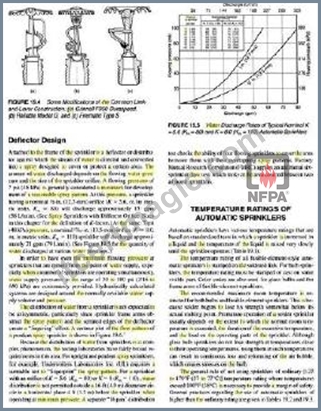
NEW QUESTION # 56
What has been the largest terrorist event in the history of the United States?
- A. The World Trade Center attack in New York
- B. The Kobar Towers military housing bombing in Daharan
- C. The Alfred P. Murrah Building bombing in Oklahoma City
- D. The bombing of Pan Am flight 103 over Lockerbie
Answer: A
NEW QUESTION # 57
In an area used for sleeping, the minimum Sound Pressure Level (SPL) required of the fire alarm system is:
- A. 75 dBA
- B. 65 dBA
- C. 70 dBA
- D. 80 dBA
Answer: D
NEW QUESTION # 58
Pressurized stairwell designs are intended to keep the interior of the stairwell.
- A. smoke free
- B. a tenable environment
- C. sufficiently ventilated for personnel flow
- D. from having a smoke obscuration of greater than 0.5 OD
Answer: C
NEW QUESTION # 59
Computers and other information technology equipment are particularly susceptible to
- A. light, hoselines, and airborn dust.
- B. special extinguishing agents.
- C. heat, steam, and combustion products.
- D. foam, metal powders, and dry chemicals.
Answer: C
Explanation:
Explanation
Computers and other information technology equipment are particularly susceptible to heat, steam, and combustion products, which can damage their sensitive components, cause data loss or corruption, and impair their functionality.Therefore, fire protection for IT equipment should consider the potential sources of heat, steam, and combustion products, such as electrical faults, flammable liquids, dust accumulation, water-based sprinklers, or smoke from adjacent areas, and implement appropriate measures to prevent, detect, and suppress fires, as well as to minimize the exposure of IT equipment to these hazards1234.References:Standard for the Fire Protection of Information Technology Equipment;Fire Protection of Computer Rooms-Legal Obligations and Best Practices - ISACA;Exploring Requirements for Information Technology Equipment;Demystifying IT room protection requirements - Consulting.
NEW QUESTION # 60
Preconnected hoses on Class II and Class III standpipes are generally limited to what length?
- A. 50 ft. (15 m)
- B. 150 ft. (45 m)
- C. 100 ft. (30.5 m)
- D. 200 ft. (61 m)
Answer: C
NEW QUESTION # 61
Water supply, power distribution, and transportation are examples of ________ targets.
- A. infrastructure
- B. ecoterrorism
- C. civilian
- D. symbolic
Answer: A
NEW QUESTION # 62
The three categories of potentially dangerous crowd situations for management are:
- A. combative, reluctant, and leaderless group
- B. critical occupancy, flight response, and craze
- C. critical flow, restricted flow, and directed flow
- D. agitated, combative, and excessive occupancy
Answer: A
NEW QUESTION # 63
The types of overspray collectors associated with spray booths can be categorized into venturi scrubbers, waterfall scrubbers, dry filter, and
- A. cyclone separator.
- B. baffle maze.
- C. vertical oscillator.
- D. cartridge filter.
Answer: D
Explanation:
Explanation
The types of overspray collectors associated with spray booths can be categorized into venturi scrubbers, waterfall scrubbers, dry filter, and cartridge filter. Venturi scrubbers use a high-velocity water spray to capture the overspray particles in a turbulent zone. Waterfall scrubbers use a curtain of water flowing over a perforated plate to wash down the overspray. Dry filter collectors use a series of filters, such as paper, fiberglass, or synthetic media, to trap the overspray. Cartridge filter collectors use pleated cartridges with high surface area and efficiency to capture the overspray. These collectors also have a self-cleaning mechanism that uses compressed air to dislodge the overspray from the cartridges.
References:Spray Booth Filters: Types and Selection;Spray Booths and Paint Finishing Operations;Spray Booth Filters: Types and Selection;Spray Booth Filters: Types and Selection;Spray Booth Filters: Types and Selection
NEW QUESTION # 64
In compliance enforcement procedures, a permit authorizes the performance of a specify activity, while which of the following grants permission to conduct or engage in any operation or act for which a level of approval is required?
- A. Authorization
- B. License
- C. Certificate
- D. Warrant
Answer: A
NEW QUESTION # 65
What NFPA document address carbon monoxide warning equipment?
- A. NFPA 1620
- B. NFPA 720
- C. NFPA 610
- D. NFPA 72
Answer: B
NEW QUESTION # 66
The minimum cover requirements for the direct burial of cable or conductors under oneand two-family dwelling driveways is:
- A. 30 in
- B. 24 in
- C. 18 in
- D. 12 in
Answer: C
Explanation:
For installations under one- and two-family dwelling driveways and outdoor parking areas, and used only for dwellingrelated purposes:
* Direct Burial Cables or Conductors need to be 18 inches (450mm) deep
* Rigid Metal Conduit or Intermediate Metal Conduit need to be 18 inches (450mm) deep
* Nonmetallic Raceways Listed for Direct Burial Without Concrete Encasement or Other Approved Raceways need to be
18 inches (450mm) deep
* Residential Branch Circuits Rated 120 Volts or Less with GFCI Protection and Maximum Overcurrent Protection of 20 Amperes need to be 12 inches (300mm) deep
* Circuits for Control of Irrigation and Landscape Lighting Limited to Not More Than 30 Volts and Installed with Type UF or in Other Identified Cable or Raceway need to be 18 inches (450mm) deep
NEW QUESTION # 67
The systems approach to fire safety:
- A. is based upon the use of the building
- B. methodically studies an entity as a whole
- C. details specification codes and standards
- D. requires fire protection devices by interconnected
Answer: A
NEW QUESTION # 68
......
Latest NFPA CFPS Dumps with Test Engine and PDF (New Questions): https://itcertspass.itcertmagic.com/NFPA/real-CFPS-exam-prep-dumps.html